| W
H Y A T T E N D |
Client Focus
— Building Effective Consulting Relationships
empowers individuals who provide support or service
to internal or external clients with the communication
and consulting skills they need to work successfully.
A two-day, instructor-led
course that is organized by the five phases
of a consulting relationship which provides
a systematic framework for building and maintaining
effective, client-focused relationships.
At the conclusion
of the course, participants will be able to:
- Establish
productive relationships with their internal
or external clients by:
- Collecting
information about the client’s needs before
the first meeting
- Understanding
the customer as a person as well as a client
- Sharing
with the client appropriate information
about one’s own personal and professional
backgrounds
- Establishing
and maintaining a trusting, open, and honest
relationship with the client
- Commit
to mutual goals with the client by:
- Clarifying
the client’s perspective on the present
status and future goals of his/her business
area
- Using
questions to help the client express his/her
perspective and to clearly define goals
to which both parties can honestly commit
themselves
- Discussing
differences of opinion with the client in
a way that demonstrates acceptance of and
respect for the client
- Plan
for results collaboratively with the client
by:
- Identifying
and eliminating potential barriers to a
desired change or improvement before trying
to implement it
- Assessing
a client’s readiness to make a change by
evaluating motivation, clarity of vision,
and the capability to implement the change
- Encouraging
a client to plan ahead even though the client
may not engage in a formal planning process
- Provide
ongoing support to the client by:
- Helping
the client anticipate problems that may
be encountered in a planned change or improvement
- Assisting
the client in evaluating his/her activities
to determine how they might be improved
- Providing
both positive and negative feedback to a
client regarding ongoing activities
- Assess
the consulting relationship by:
- Soliciting
feedback from the client on how the client’s
needs might be better served
- Discussing
the status of the relationship with the
client and how it might be improved
- Recognizing
and celebrating the accomplishments of the
client.
Client Focus
is designed to be highly participative. Participants
work through the various phases of the relationship
development process using video-based case studies.
The large majority
of key content is taught through practical work
tools that are immediately applied to the three
video-based case examples. These cases are followed
through all five phases of the consulting process.
Role-plays, discussions and self-analysis activities
are also included for variety and instructional
effectiveness. Participants also use Relationship
Analyzers, which are one-page summary checklists
linked to the phases of the consulting process,
to analyze an actual client situation of their
own.
|
|
|
|
| W
H O S H O U L D A T T E N D |
Because the work
tools have been designed to be sensitive to culturally
diverse environments, the course has been successfully
used with international audiences:
- For novice
participants, it provides both basic concepts
and principles.
- For experienced
participants, it provides opportunity to amplify
the concepts and principles through reflection
of their work experience.
Team
attendance highly recommended
This is to facilitate
successful implementation of the theory learned
and establish a common framework to practice in
real-life environment. The interactive and highly
participative nature of the course and the application
of specific tools and skills to participants’
jobs enhance skill transfer and allow participants
to learn from one another.
Certificate
of Participation will
be awarded.
| YOU
WILL RECEIVE POWERFUL RESOURCES |
- The Participant
Guide provides key concepts, worksheets
and work tools used during classroom activities.
- The Reference
Guide contains copies of all of the work
tools so they may be easily copied for use
on the job.
- Three
video-based case studies are used throughout
all phases of the program to model appropriate
skills and techniques, to promote discussion,
and to practice application of the work tools.
The cases represent three diverse consulting
situations to encourage participants to think
outside of their normal paradigms with respect
to client relationships.
- The Facilitator
Guide provides the overall “road map”
for the course. It serves both as a preparation
tool for instructors as well as a step-by-step
guide for conducting course sessions. The
Guide’s unique, easy-to-use format has been
frequently cited by instructors as extremely
effective for use in initial preparation and
on-going support.
|
|
|
|
| P
R O G R A M C O N T E N T |
Case Study
Approach is
used throughout the program. Each phase of the
Client Focus process is applied to the case in
class discussion and team exercises.
| PHASE
1: ESTABLISHING A RELATIONSHIP |
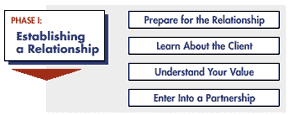 A.
Prepare for the relationship A.
Prepare for the relationship
• Importance
of gathering information about client prior
to first visit
• Areas of importance
to understand about the client
• Methods of
obtaining information about the client
B. Learn about
the customer
• Importance
of understanding the business person
• A client’s
need for respect
• A client’s
need for control
C. Understand your
value
• Understanding
your value to the client
• Identifying
opportunities for growth
• Sharing information
about yourself with the client
D. Enter into a
partnership
• Establishing
trust and mutual understanding
• Indicators
of effective relationships
| PHASE
2: REACHING AGREEMENT |
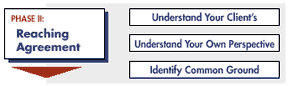 A.
Understand your client’s perspective A.
Understand your client’s perspective
• Determining
client perception (beliefs and feelings) about
the
current
situation
• Relationship
of perception of the current situation to actual
facts
• Determining
client beliefs, feelings, and wishes about the
future
• Clarifying
client goals (versus wishes)
• Asking effective
questions
B. Understand your
own perspective
• Clarifying
your own perspective about the current situation
and the future
• Identifying
differences between your perspective and the
client’s
• Challenging
your own beliefs, feelings and wishes
• Clarifying
your own goals
C. Identify common
ground
• Importance
of mutual commitment
• Agreeing to
disagree
• Maintaining
mutual respect when disagreeing
• Identifying
common ground by examining underlying beliefs
and feelings
| PHASE
3: PLANNING FOR RESULTS |
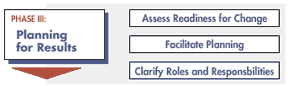 A.
Assess readiness for change A.
Assess readiness for change
• Importance
of change
• Consultant
as change agent
• Barriers to
change
• Readiness for
change
• Vision, motivation,
and capability
B. Facilitate planning
• Planning
as an everyday, ongoing activity
• Psychological
and practical barriers to planning
• Eliminating
planning barriers
• Plans as leverage
for change
• Anticipating
long-term consequences and challenges
C. Clarify roles
and responsibilities
• Taking
control versus providing support
• Understanding
individual stylistic preferences in consulting
relationships
• Adjusting your
style to fit the situation
• Accountability
and responsibility
| PHASE
4: PROVIDING SUPPORT |
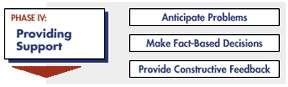 A.
Anticipate problems A.
Anticipate problems
• Underlying
assumptions about problems being addressed
• Unanticipated
changes in the environment
• Current and
future processes
• Coordination
and communication
• Unanticipated
impact
B. Support client
decisions
• Clarifying
the decision
• Identifying
the right questions to ask
• Identifying/selecting
sources of information
• Collecting/analyzing
the information
• Making a decision
and following-up the decision
C. Provide constructive
feedback
• Importance
of a trusting relationship
• Recognition
of client’s need for respect and control
• Focus on mutual
goals and emphasis on the future
• Assuming the
client’s perspective
| PHASE
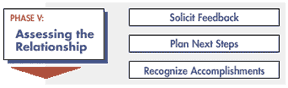
5: ASSESSING THE RELATIONSHIP |
 A.
Solicit feedback A.
Solicit feedback
• Importance
of customer feedback
• Overcoming
barriers to soliciting feedback
• Obtaining and
providing honest feedback
• Accepting compliments
and criticism
B. Plan next steps
• Keeping
the client relationship at the forefront
• Continuous
assessment at each phase of the relationship
C. Recognize accomplishments
• Recognition
and Celebration
|
|
|
|
| R
E G I S T R A T I O N D E T A I L
S |
|
Date
Time
Venue
|
January
21-22, 2002
9.00am
- 5.00pm
Century
Hotel, Kuala Lumpur
(along
Jalan Bukit Bintang) |
|
|
Incentives
|
RM1,280.00
per person, inclusive of course materials, lunches,
refreshments
Take
RM200 OFF the fee - pay before Jan 11, 2002
Take
another 10% OFF for 3 or more from the same organisation
FREE Subscription
to The
Economy Commentary |
|
Reservation
|
Reservation
can be made by telephone, telefax or by e-mail.
Registration is confirmed on receipt of registration
form and payment must be cleared before program
date. If unable to do so due to government
policy or company procedure, please advise late
payment in writing. |
|
Cancellation
Policy
|
Cancellations
are valid only in writing. Full refunds applicable
if written notice is received at least 2 weeks
before each program. A 25% cancellation fee will
be levied for cancellations received less than
2 weeks before the program. No refunds after commencement
of seminar. Substitutions are allowed. |
|
SBL
SCHEME
HRD
COUNCIL
|
RAYMA
is an Approved Training Provider with HRDC whereby
approved training programs can qualify for 75%
rebate of the fee. Please apply through your HR
Department at least 30 days in advance of the
program. |
|
THE
RAYMA
GUARANTEE
|
A
full refund to you if we do not deliver what we
promised.
Just
turn in your workbook at the end of the day! |
|
|
In-company
Customised Learning Solutions
Need
to develop entire teams? All our public programs,
based on best practices, can be developed in partnership
with you to meet your organization's specific
requirements. DETAILS |
|
REGISTRATION
&
ENQUIRIES

|
RAYMA Sdn
Bhd
2B Jalan SS24/13,
Taman Megah, 47301 Petaling Jaya
Selangor Darul
Ehsan, Malaysia
Tel: +60 3 7804
4666
Fax: +60 3 7804
4484
E-mail: seminars@rayma.com.my |
-

|
|
|